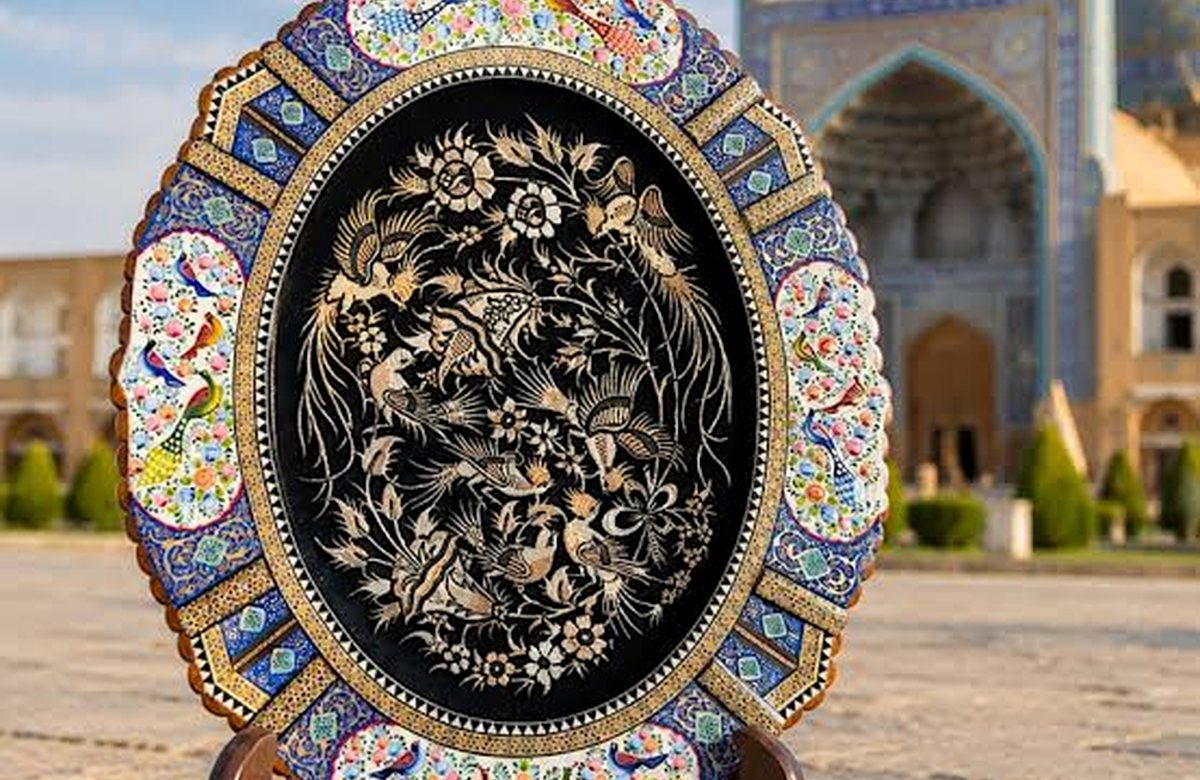
Persian craft changes as the landscape, economy and workshop culture change. Regional traditions are therefore best understood as networks rather than fixed labels. A broad guide to Persian handicrafts, from enamel and marquetry to textiles, carpets, metalwork, ceramics and regional workshop traditions.
Place and material
A pile carpet is constructed on a system of warp and weft, with knots tied around warp threads to create the patterned surface. Fibre, knot density, design and finishing all influence the result. Persian carpets are regional rather than uniform. Workshop carpets, village rugs and nomadic weavings can follow very different design systems and material priorities.
The strongest examples usually feel controlled rather than mechanically perfect: the eye can sense rhythm without losing the presence of the hand. Regional identity is strongest when it is tied to observable materials, techniques and market histories rather than vague claims of exclusivity.
Workshop traditions
UNESCO recognises traditional carpet-weaving skills in both Kashan and Fars, underscoring that weaving knowledge is embedded in specific communities and methods. Persian ceramics span many periods and techniques, including glazed earthenware and stonepaste traditions. Colour, body, glaze and painted decoration changed with technology and trade.
It is also worth separating historical association from modern marketing. A living craft can be valuable without pretending every contemporary object is an unchanged survival from antiquity. Regional identity is strongest when it is tied to observable materials, techniques and market histories rather than vague claims of exclusivity.
What moves between regions
Blue-and-white ceramics in Safavid Iran demonstrate how Persian workshops could absorb global visual exchange while producing locally meaningful forms. Persian tilework can be read as architecture and graphic design at once. Repeating units create large surfaces while calligraphy and vegetal ornament establish hierarchy.
For a contemporary buyer, this creates a useful balance between visual pleasure and informed judgement. Regional identity is strongest when it is tied to observable materials, techniques and market histories rather than vague claims of exclusivity.
How to read regional labels
Different periods and buildings use different techniques, including mosaic tile and painted multi-colour tiles; it is better to identify a method carefully than to treat all tile surfaces as the same craft. Textiles reveal craft through touch as much as sight. Fibre, weave, print, dye and finishing determine how a cloth hangs, ages and responds to use.
Seen this way, the object becomes more than a souvenir; it becomes evidence of a process, a material choice and a particular visual culture. Regional identity is strongest when it is tied to observable materials, techniques and market histories rather than vague claims of exclusivity.
- A pile carpet is constructed on a system of warp and weft, with knots tied around warp threads to create the patterned surface. Fibre, knot density, design and finishing all influence the result.
- Persian carpets are regional rather than uniform. Workshop carpets, village rugs and nomadic weavings can follow very different design systems and material priorities.
- UNESCO recognises traditional carpet-weaving skills in both Kashan and Fars, underscoring that weaving knowledge is embedded in specific communities and methods.
Sources & further reading
- UNESCO Intangible Cultural Heritage — Iran
- The Metropolitan Museum of Art — Heilbrunn Timeline
- Encyclopaedia Iranica
This Journal is written as accessible editorial guidance, not as an attribution or authentication service. Dates, workshop practices and regional labels can vary by object.