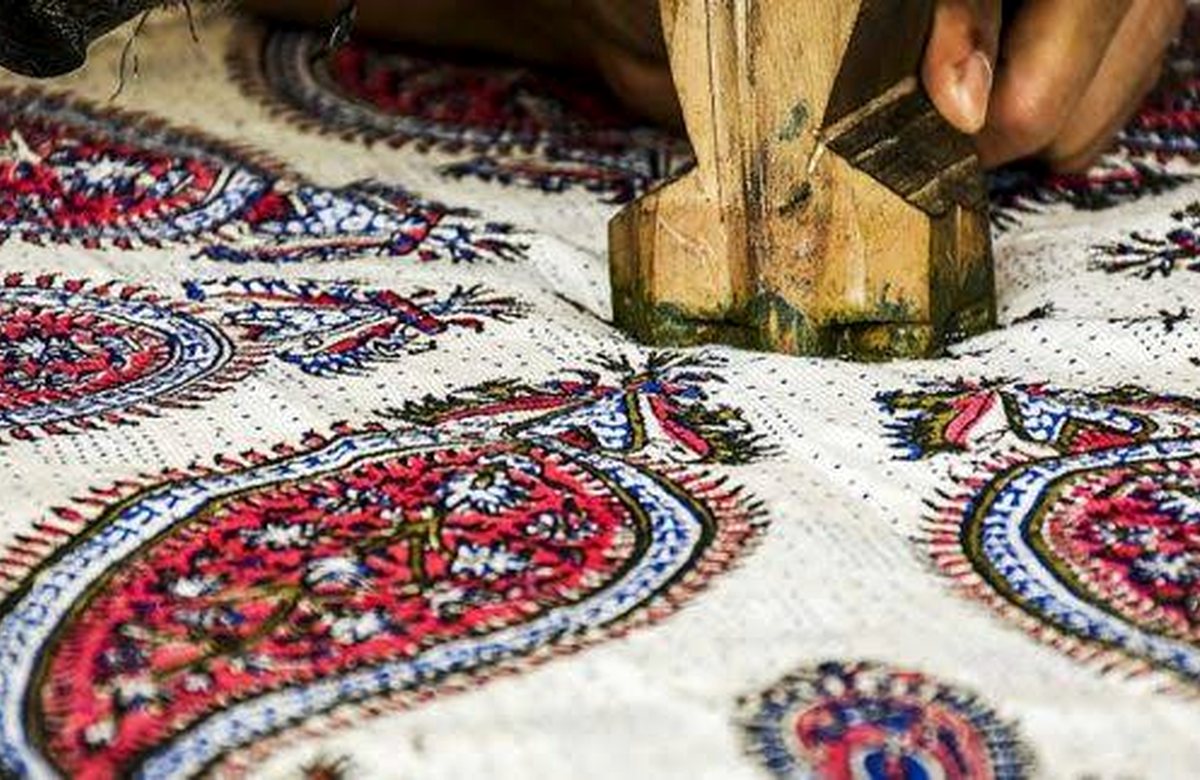
Before thinking about price or decoration, it helps to understand what the maker actually has to do to produce the object. Termeh combines dense pattern, refined weaving and motifs such as the boteh in one of Persia’s most recognisable textile traditions.
Start with the process
Termeh is a densely patterned woven textile associated especially with central Iran and Yazd. It is known for refined repeating motifs, including forms related to the boteh. The appeal of termeh comes from weave and colour working together; printed imitations can reproduce a pattern but not the same woven structure.
Seen this way, the object becomes more than a souvenir; it becomes evidence of a process, a material choice and a particular visual culture. A photograph can show colour and pattern, but close inspection also asks about edges, joins, reverse surfaces and the transitions between materials.
Materials and handwork
Persian tilework can be read as architecture and graphic design at once. Repeating units create large surfaces while calligraphy and vegetal ornament establish hierarchy. Different periods and buildings use different techniques, including mosaic tile and painted multi-colour tiles; it is better to identify a method carefully than to treat all tile surfaces as the same craft.
That distinction matters because decorative complexity can hide poor finishing just as easily as it can reveal skill. A photograph can show colour and pattern, but close inspection also asks about edges, joins, reverse surfaces and the transitions between materials.
How to judge the surface
The boteh is a curved, tapering motif found across Persian textiles and carpets. In Europe and later global fashion, related forms became associated with the word paisley. Its exact symbolic interpretation varies, so it is safer to appreciate the boteh as a durable visual form rather than assign one fixed ancient meaning.
The strongest examples usually feel controlled rather than mechanically perfect: the eye can sense rhythm without losing the presence of the hand. A photograph can show colour and pattern, but close inspection also asks about edges, joins, reverse surfaces and the transitions between materials.
Living with the finished piece
Textiles reveal craft through touch as much as sight. Fibre, weave, print, dye and finishing determine how a cloth hangs, ages and responds to use. Persian textile traditions include urban workshop production as well as village and nomadic practices, so one label cannot describe every object.
It is also worth separating historical association from modern marketing. A living craft can be valuable without pretending every contemporary object is an unchanged survival from antiquity. A photograph can show colour and pattern, but close inspection also asks about edges, joins, reverse surfaces and the transitions between materials.
- Termeh is a densely patterned woven textile associated especially with central Iran and Yazd. It is known for refined repeating motifs, including forms related to the boteh.
- The appeal of termeh comes from weave and colour working together; printed imitations can reproduce a pattern but not the same woven structure.
- Persian tilework can be read as architecture and graphic design at once. Repeating units create large surfaces while calligraphy and vegetal ornament establish hierarchy.
Sources & further reading
- Victoria and Albert Museum — Islamic Middle East collections
- The Metropolitan Museum of Art — Art of the Islamic world
- UNESCO Intangible Cultural Heritage — Iran
This Journal is written as accessible editorial guidance, not as an attribution or authentication service. Dates, workshop practices and regional labels can vary by object.