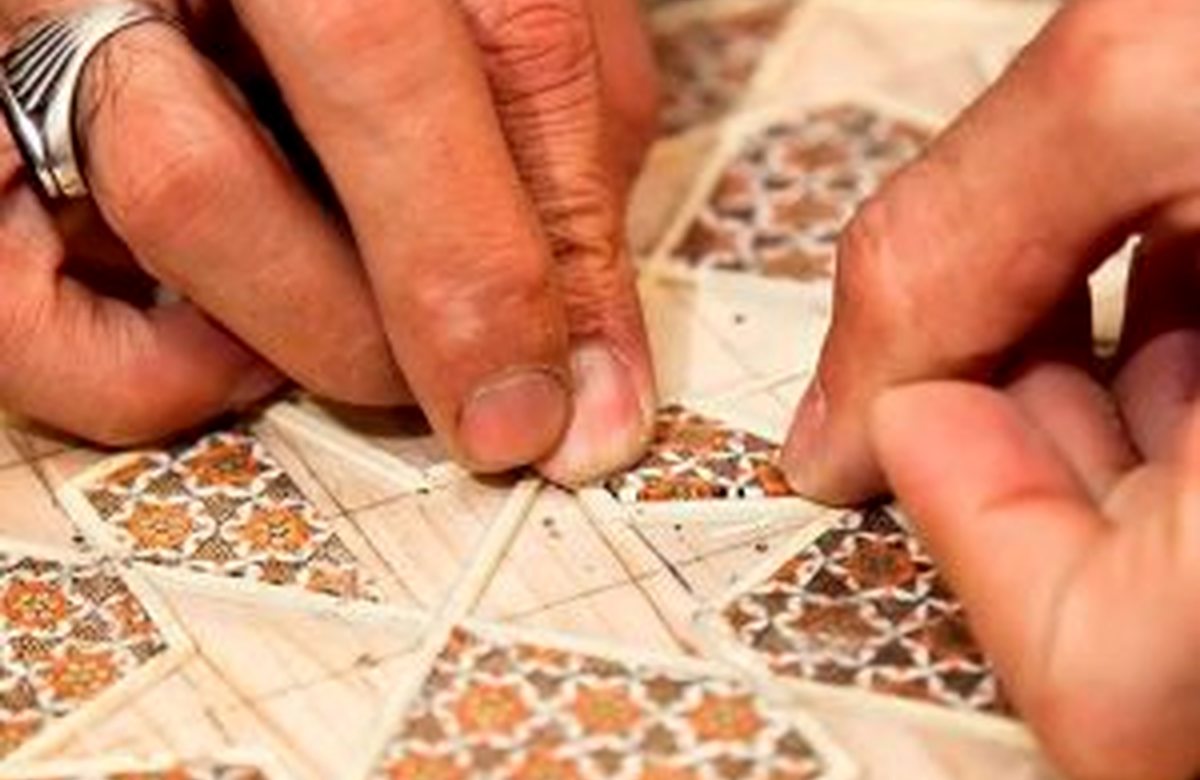
This is a technique where the process remains visible in the object. Small differences in line, alignment, surface and colour can reveal how much work happened by hand. A step-by-step look at the bundles, slices and repeating polygons that make khatam patterns appear impossibly precise.
Start with the process
Khatam is a form of marquetry built from tiny polygonal elements. Makers assemble long bundles from contrasting materials, slice them into thin sections, and apply those sections to a prepared surface. The illusion of complexity comes from repetition at very small scale. Alignment, density and clean transitions around corners are useful clues when comparing pieces.
Seen this way, the object becomes more than a souvenir; it becomes evidence of a process, a material choice and a particular visual culture. A photograph can show colour and pattern, but close inspection also asks about edges, joins, reverse surfaces and the transitions between materials.
Materials and handwork
Traditional-looking khatam may combine woods with light-coloured bone and metallic elements such as brass; contemporary workshops may substitute materials while preserving the geometric logic. It is also worth separating historical association from modern marketing. A living craft can be valuable without pretending every contemporary object is an unchanged survival from antiquity.
That distinction matters because decorative complexity can hide poor finishing just as easily as it can reveal skill. A photograph can show colour and pattern, but close inspection also asks about edges, joins, reverse surfaces and the transitions between materials.
How to judge the surface
For a contemporary buyer, this creates a useful balance between visual pleasure and informed judgement. Seen this way, the object becomes more than a souvenir; it becomes evidence of a process, a material choice and a particular visual culture.
The strongest examples usually feel controlled rather than mechanically perfect: the eye can sense rhythm without losing the presence of the hand. A photograph can show colour and pattern, but close inspection also asks about edges, joins, reverse surfaces and the transitions between materials.
Living with the finished piece
Khatam is a form of marquetry built from tiny polygonal elements. Makers assemble long bundles from contrasting materials, slice them into thin sections, and apply those sections to a prepared surface. The illusion of complexity comes from repetition at very small scale. Alignment, density and clean transitions around corners are useful clues when comparing pieces.
It is also worth separating historical association from modern marketing. A living craft can be valuable without pretending every contemporary object is an unchanged survival from antiquity. A photograph can show colour and pattern, but close inspection also asks about edges, joins, reverse surfaces and the transitions between materials.
- Khatam is a form of marquetry built from tiny polygonal elements. Makers assemble long bundles from contrasting materials, slice them into thin sections, and apply those sections to a prepared surface.
- The illusion of complexity comes from repetition at very small scale. Alignment, density and clean transitions around corners are useful clues when comparing pieces.
- Traditional-looking khatam may combine woods with light-coloured bone and metallic elements such as brass; contemporary workshops may substitute materials while preserving the geometric logic.
Sources & further reading
- Victoria and Albert Museum — Islamic Middle East collections
- The Metropolitan Museum of Art — Art of the Islamic world
- UNESCO Intangible Cultural Heritage — Iran
This Journal is written as accessible editorial guidance, not as an attribution or authentication service. Dates, workshop practices and regional labels can vary by object.