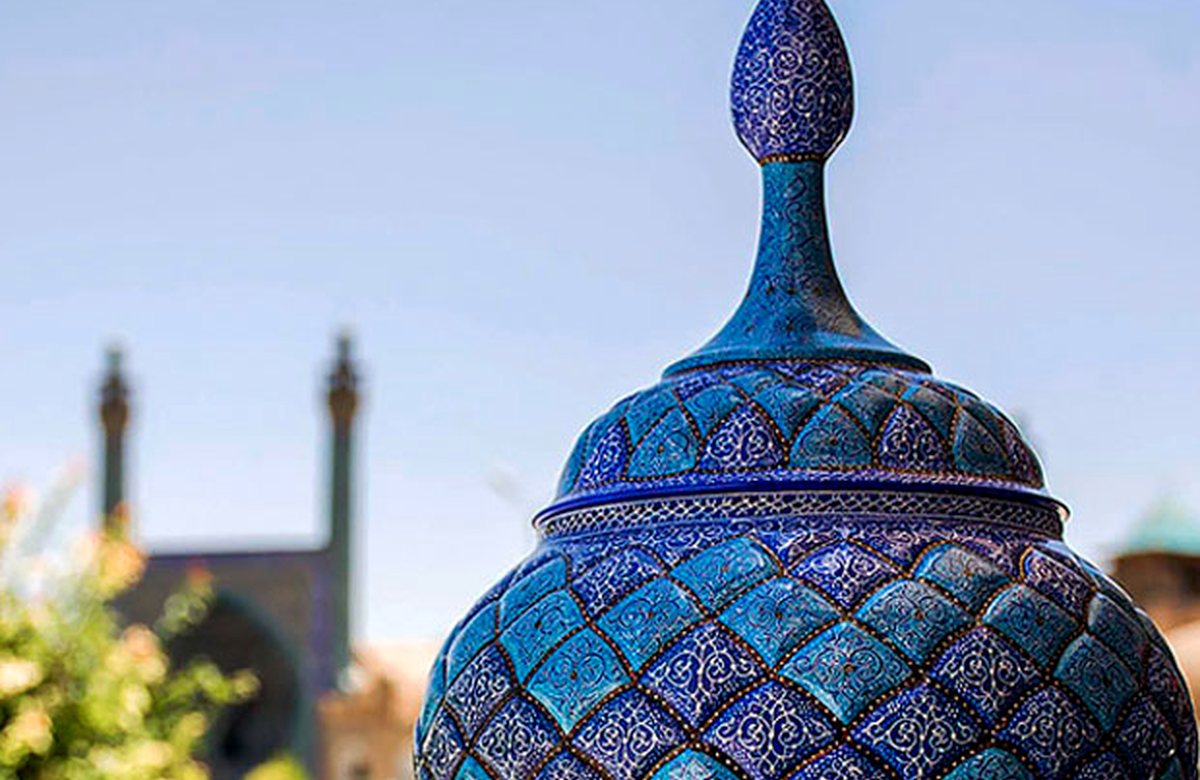
This is a technique where the process remains visible in the object. Small differences in line, alignment, surface and colour can reveal how much work happened by hand. A guide to firoozeh-koobi, where small turquoise fragments are set densely across copper forms and polished into a jewel-like surface.
Start with the process
Firoozeh-koobi uses small turquoise fragments to create a dense mosaic-like surface, commonly over copper forms. The visual effect depends on stone density, colour variation and how cleanly the inlaid field meets the exposed metal. The craft is comparatively modern in its current form, which is a useful reminder that Persian craft is a living field rather than a museum of unchanged ancient techniques.
It is also worth separating historical association from modern marketing. A living craft can be valuable without pretending every contemporary object is an unchanged survival from antiquity. A photograph can show colour and pattern, but close inspection also asks about edges, joins, reverse surfaces and the transitions between materials.
Materials and handwork
Turquoise-inlaid pieces should be treated gently: soaking, harsh chemicals and aggressive polishing can damage the setting or dull the stone. Turquoise from northeastern Iran, especially the Neyshabur area, has a long reputation in jewellery and decorative art. Natural stone varies in colour, matrix and surface character.
For a contemporary buyer, this creates a useful balance between visual pleasure and informed judgement. A photograph can show colour and pattern, but close inspection also asks about edges, joins, reverse surfaces and the transitions between materials.
How to judge the surface
The colour turquoise also became important beyond the stone itself, especially in tilework and enamel. It is also worth separating historical association from modern marketing. A living craft can be valuable without pretending every contemporary object is an unchanged survival from antiquity.
Seen this way, the object becomes more than a souvenir; it becomes evidence of a process, a material choice and a particular visual culture. A photograph can show colour and pattern, but close inspection also asks about edges, joins, reverse surfaces and the transitions between materials.
Living with the finished piece
Firoozeh-koobi uses small turquoise fragments to create a dense mosaic-like surface, commonly over copper forms. The visual effect depends on stone density, colour variation and how cleanly the inlaid field meets the exposed metal. The craft is comparatively modern in its current form, which is a useful reminder that Persian craft is a living field rather than a museum of unchanged ancient techniques.
That distinction matters because decorative complexity can hide poor finishing just as easily as it can reveal skill. A photograph can show colour and pattern, but close inspection also asks about edges, joins, reverse surfaces and the transitions between materials.
- Firoozeh-koobi uses small turquoise fragments to create a dense mosaic-like surface, commonly over copper forms. The visual effect depends on stone density, colour variation and how cleanly the inlaid field meets the exposed metal.
- The craft is comparatively modern in its current form, which is a useful reminder that Persian craft is a living field rather than a museum of unchanged ancient techniques.
- Turquoise-inlaid pieces should be treated gently: soaking, harsh chemicals and aggressive polishing can damage the setting or dull the stone.
Sources & further reading
- Victoria and Albert Museum — Islamic Middle East collections
- The Metropolitan Museum of Art — Art of the Islamic world
- UNESCO Intangible Cultural Heritage — Iran
This Journal is written as accessible editorial guidance, not as an attribution or authentication service. Dates, workshop practices and regional labels can vary by object.