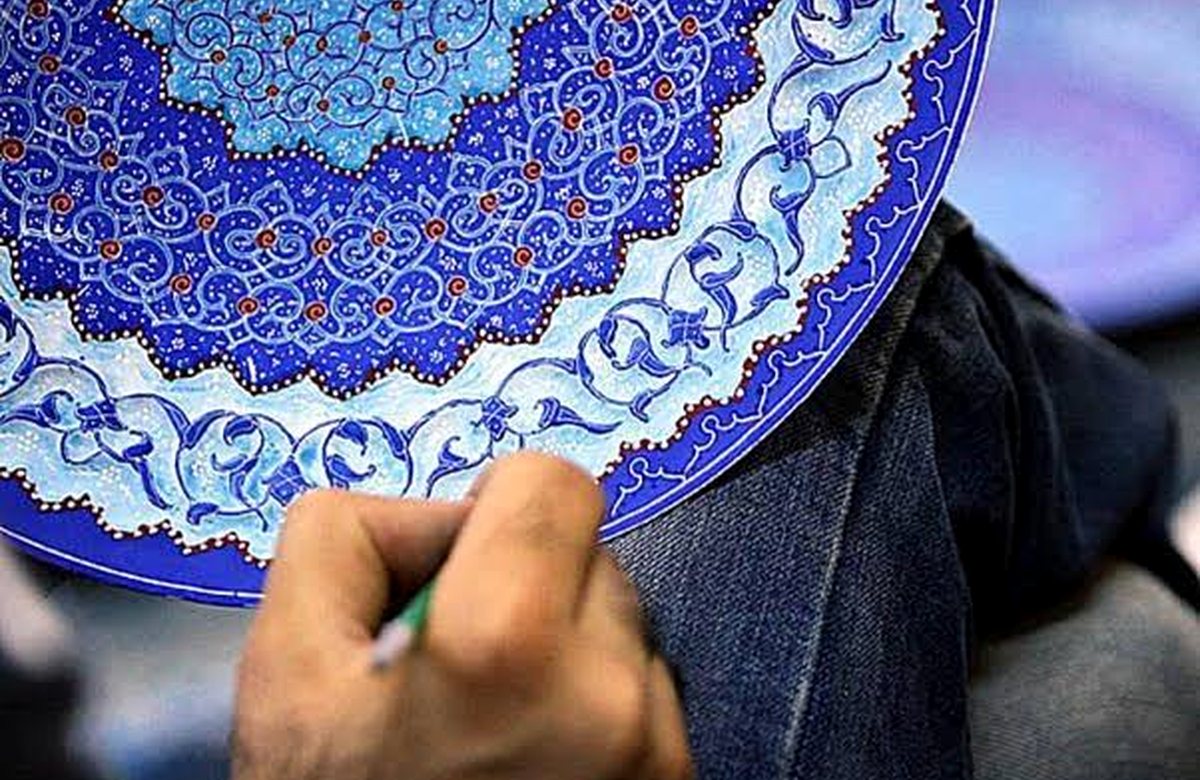
Handmade Persian objects often carry more pattern than contemporary furniture, which is exactly why restraint around them works so well. Simple shelves, negative space and controlled colour help hand-painted enamel feel fresh in a modern room.
Start with scale
Minakari is most often encountered as enamel decoration on metal, especially copper. The surface is prepared, enamelled, painted and fired so colour becomes part of a hard glass-like layer rather than a simple surface coating. Fine examples reward close viewing: brush lines should feel intentional, borders should be controlled, and the enamel should cover the metal consistently without distracting pits or rough edges.
It is also worth separating historical association from modern marketing. A living craft can be valuable without pretending every contemporary object is an unchanged survival from antiquity. Try the object in one location for several days before adding more around it; good placement often feels calmer after the first impulse to decorate has passed.
Give pattern room
Blue and turquoise are strongly associated with contemporary minakari, but the quality of a piece depends more on drawing, firing and finish than on any single colour. Intricate craft usually looks strongest when surrounded by quieter materials. Negative space lets pattern register instead of competing with other ornament.
For a contemporary buyer, this creates a useful balance between visual pleasure and informed judgement. Try the object in one location for several days before adding more around it; good placement often feels calmer after the first impulse to decorate has passed.
Build the palette slowly
Scale matters: a small detailed object belongs where people can approach it, while a textile or larger vessel can carry visual weight from across a room. It is also worth separating historical association from modern marketing. A living craft can be valuable without pretending every contemporary object is an unchanged survival from antiquity.
Seen this way, the object becomes more than a souvenir; it becomes evidence of a process, a material choice and a particular visual culture. Try the object in one location for several days before adding more around it; good placement often feels calmer after the first impulse to decorate has passed.
Make the object usable
Minakari is most often encountered as enamel decoration on metal, especially copper. The surface is prepared, enamelled, painted and fired so colour becomes part of a hard glass-like layer rather than a simple surface coating. Fine examples reward close viewing: brush lines should feel intentional, borders should be controlled, and the enamel should cover the metal consistently without distracting pits or rough edges.
That distinction matters because decorative complexity can hide poor finishing just as easily as it can reveal skill. Try the object in one location for several days before adding more around it; good placement often feels calmer after the first impulse to decorate has passed.
- Minakari is most often encountered as enamel decoration on metal, especially copper. The surface is prepared, enamelled, painted and fired so colour becomes part of a hard glass-like layer rather than a simple surface coating.
- Fine examples reward close viewing: brush lines should feel intentional, borders should be controlled, and the enamel should cover the metal consistently without distracting pits or rough edges.
- Blue and turquoise are strongly associated with contemporary minakari, but the quality of a piece depends more on drawing, firing and finish than on any single colour.
Sources & further reading
- Victoria and Albert Museum — Islamic Middle East collections
- The Metropolitan Museum of Art — Heilbrunn Timeline
This Journal is written as accessible editorial guidance, not as an attribution or authentication service. Dates, workshop practices and regional labels can vary by object.